MULTILATERAL GROUPING · G20
G20
Group of Twenty
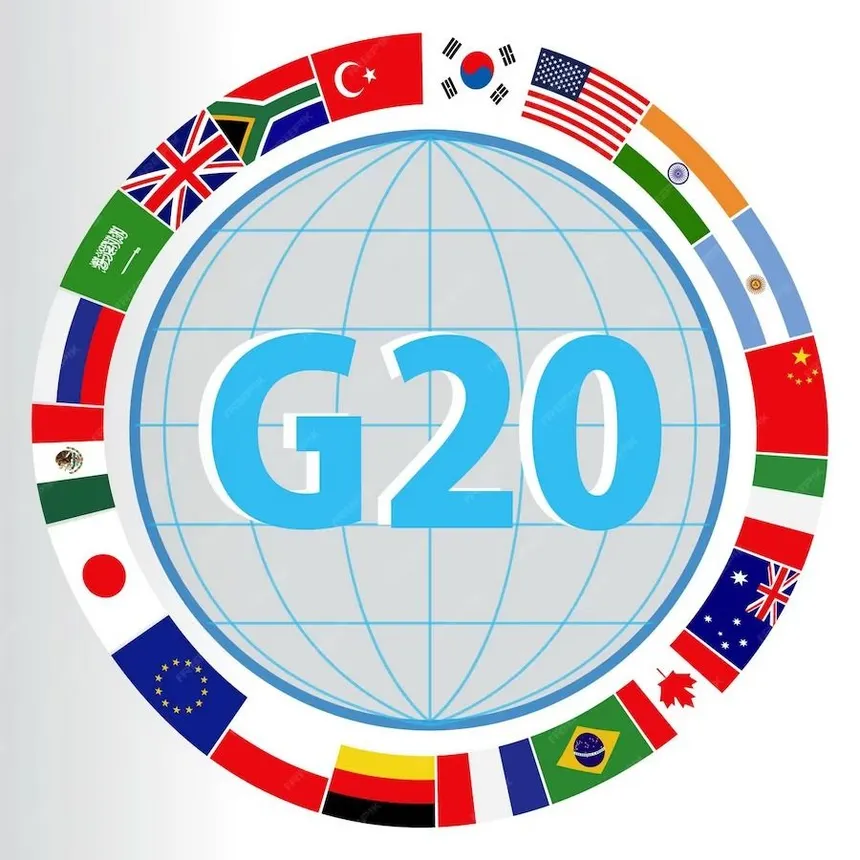
The Group of Twenty (G20) is an international forum comprising 19 sovereign countries and two regional bodies (the European Union and the African Union) that serves as the premier global platform for discussing and coordinating international economic policy. Established in 1999 following the Asian financial crisis and elevated to heads-of-state level in 2008, the G20 addresses critical global issues including financial stability, climate change, trade, and sustainable development. Collectively, G20 members represent approximately 85% of global GDP, 75% of global trade, and two-thirds of the world’s population. The forum operates under a rotating annual presidency with no permanent secretariat, steering its agenda through parallel Finance Track and Sherpa Track meetings before culminating in an annual leaders' summit. Recent summits have highlighted themes such as solidarity and sustainability (South Africa 2025), green transitions and digital infrastructure (India 2023), and the integration of emerging economies into global governance.
MEMBER STATES
The 20 members and what each brings

Brazil
Latin America
BRINGS TO THE TABLE
- Agricultural exports, biofuel technology, G20 coordination

Argentina
Latin America
BRINGS TO THE TABLE
- Inclusive Growth, Fair and Sustainable development, Gender Mainstreaming

India
Swing state
BRINGS TO THE TABLE
- Soft Power, Developmental Expertise, Global South voice

China
Largest economy
BRINGS TO THE TABLE
- Global Development, Infrastructure Investment, Multilateralism

South Africa
African Continent
BRINGS TO THE TABLE
- Solidarity, Equality, Sustainablity

Italy
EU member
BRINGS TO THE TABLE
- Global Health, Climate Change, Inclusive Economic Recovery

Turkey
mid-size economic power
BRINGS TO THE TABLE
- Energy Security, Global Financial Stability, Middle East Peace

Australia
Oceania
BRINGS TO THE TABLE
- Diplomatic Bridge-Building, Regional Leadership in the Asia-Pacific, Specialized Policy Expertise

Indonesia
Largest Economy in Southeast Asia
BRINGS TO THE TABLE
- Global Financial Stability, Debt Restructuring, Equitable Resource Distribution

Saudi Arabia
World's Largest Oil Exporter
BRINGS TO THE TABLE
- Circular Carbon Economy (CCE), Digital Health, Space Economy

Germany
Global Alliance Against Hunger and Poverty
BRINGS TO THE TABLE
- Multilateralism, Sustainable Development, Climate Action

France
EU member
BRINGS TO THE TABLE
- Global Economic Governance Reform, Financial Stability, Inclusive Growth.

Japan
G7 Member
BRINGS TO THE TABLE
- Inclusive, Sustainable, and Human-Centered Global Development

Canada
Entrepreneurial leadership
BRINGS TO THE TABLE
- Sustainable Infrastructure, Climate Resilience, Pandemic Preparedness

Mexico
World’s 14th Largest Economy
BRINGS TO THE TABLE
- Poverty Reduction, Gender Equality, and Inclusive Development

South Korea
Advanced Economy
BRINGS TO THE TABLE
- Hosting and Leadership, Innovation and Digital Equity, Global Financial Stability

Russia
Major energy and food exporter
BRINGS TO THE TABLE
- Global Energy Security, Food Security, Advocating for Financial Stability

United Kingdom
EU member
BRINGS TO THE TABLE
- Stable Growth, Fair Trade, International Financial Stability

United States
Global Superpower
BRINGS TO THE TABLE
- Unleashing Economic Prosperity by limiting Regulatory burdens, Unlocking Affordable and Secure Energy Supply Chains, Pioneering Innovations in AI and Emerging Technologies
PRIORITY AREAS
Six themes, project-by-project execution
New Development Bank
The NDB, headquartered in Shanghai, has approved $33bn in loans as of 2025. India is the largest borrower, with funding for urban infrastructure, clean energy, and disaster risk reduction.
Flagship: $33bn approved
Trade in local currencies
BRICS members are expanding bilateral trade settlement in local currencies - rupee-ruble and rupee-yuan mechanisms are operational. India's position: currency diversification yes, dollar replacement no.
Global South governance reform
BRICS coordinates positions on IMF reform, WTO dispute resolution, and UN Security Council expansion. India pushes for permanent UNSC seat; China's position is more ambivalent.
Technology and digital
A BRICS Technology Transfer Centre framework is under discussion. India promotes its Digital Public Infrastructure (UPI, Aadhaar) model as a Global South template through BRICS channels.
Health and pharma
Coordinated vaccine and medicine access was a key COVID-era focus. India's pharma exports to BRICS members - particularly Russia, Brazil, and South Africa - total $4.5bn annually.
INDIA'S ROLE
What India brings, what India gets
India is BRICS's most strategically independent member. It benefits from NDB financing and the Global South coordination platform, but consistently differentiates its positions from China and Russia on geopolitical questions. India did not sign the Johannesburg Declaration language on the Russia-Ukraine war, and continues bilateral talks with China outside the BRICS framework. India's value to BRICS is its credibility as the world's largest democracy and its convening power with the Global South - particularly African and Southeast Asian nations.
INDIA CONTRIBUTES
- ·Largest democracy - legitimacy for the grouping
- ·Strategic autonomy - buffer between China and the West
- ·Digital Public Infrastructure leadership
- ·Pharmaceutical manufacturing for Global South
INDIA RECEIVES
- ·NDB financing for infrastructure projects
- ·Currency diversification mechanisms
- ·G20 and UN coordination with emerging economies
- ·A platform to advocate UNSC expansion
OUTCOMES TO DATE
What G20 has actually produced
UPDATED 12 MAY 2026
FLAGSHIP 01
$33bn
Approved since 2015 · India largest borrower
New Development Bank has funded 96 projects across member countries. India has drawn the most - urban infrastructure, clean energy, and disaster risk reduction are priority sectors.
FLAGSHIP 02
32%
Post-2024 expansion · PPP basis
BRICS-10 represents 32% of global GDP on PPP basis, surpassing the G7's share for the first time in 2023.