MULTILATERAL GROUPING · IBSA
IBSA
India · Brazil · South Africa Dialogue Forum
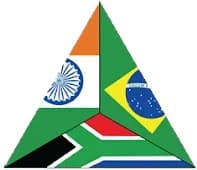
The India-Brazil-South Africa Dialogue Forum is a trilateral grouping of three large Southern democracies — one from each of Asia, Latin America, and Africa — formed in 2003 to coordinate Global South positions on trade, governance, and development. Unlike BRICS, which includes China and Russia, IBSA is explicitly a forum of democracies, making it a distinctive voice within the broader Global South coalition. Operating through 14 working groups, 6 people-to-people forums, and the IBSA Fund for poverty alleviation, the grouping has punched above its weight on UN reform, WTO negotiations, and development cooperation. The November 2025 IBSA Leaders' Meeting — held on the sidelines of the G20 Johannesburg Summit — reinvigorated the forum after a period of relative dormancy, with PM Modi calling IBSA 'a key platform connecting three continents, democracies, and economies.'
MEMBER STATES
The 3 members and what each brings

India
Asia anchor
BRINGS TO THE TABLE
- Digital Public Infrastructure, pharmaceutical exports, Global South convening

Brazil
Latin America anchor
BRINGS TO THE TABLE
- Agricultural technology, biofuels, G20 coordination, Amazon climate diplomacy

South Africa
Africa anchor
BRINGS TO THE TABLE
- African Union voice, minerals, 2025 G20 presidency
PRIORITY AREAS
Six themes, project-by-project execution
South-South development cooperation
The IBSA Fund — established in 2004 — pools $1 million annually from each member country to finance development projects in the Global South. As of 2025, it has allocated $47 million across 45 projects in 38 countries, delivering $35 million in direct benefits to vulnerable populations. Projects span agriculture, sanitation, health, education, and disaster risk reduction. It is one of the most successful South-South development financing mechanisms in operation.
Flagship: $47m · 45 projects · 38 countries
UN & multilateral governance reform
IBSA is a coordinated voice for permanent UN Security Council seats for all three members. India, Brazil, and South Africa each seek permanent UNSC representation and coordinate positions at the UN General Assembly. The November 2025 Leaders' Meeting specifically foregrounded UNSC reform as a priority. IBSA also coordinates on WTO reform, IMF governance, and the reform of other Bretton Woods institutions.
Digital transformation & AI governance
The 2025 Leaders' Meeting elevated digital transformation and AI as a new IBSA priority. The three nations agreed to coordinate on developing 'safe, trustworthy, and human-centric AI norms' — positioning the democratic Global South as a counterweight to both US Big Tech governance and China's state-centric AI model. India's Digital Public Infrastructure stack (UPI, Aadhaar) is offered as a model for Brazil and South Africa.
Climate & energy transition
All three IBSA members are major emerging economies with significant fossil-fuel dependencies and large renewable energy potential. The grouping coordinates on just energy transitions, climate finance access, and loss-and-damage mechanisms at COP and G20. Brazil's Amazon diplomacy, South Africa's coal phase-out, and India's solar expansion are all shared reference points. IBSA pushes for differentiated responsibilities for developed vs developing nations on climate timelines.
Health, food security & poverty
IBSA's founding agenda included health (HIV/AIDS cooperation), food security, and poverty reduction. India's pharmaceutical sector — supplying affordable generics to Brazil and South Africa — is a key pillar. The IBSA Fund has funded water and sanitation projects across sub-Saharan Africa and South Asia. South Africa's leadership on HIV/AIDS treatment access and Brazil's expertise on conditional cash-transfer programmes (Bolsa Família) complement India's health and nutrition outreach.
INDIA'S ROLE
What India brings, what India gets
India is IBSA's most diplomatically active member and the grouping's largest economy. The forum serves India's strategic interest in building a democratic Global South coalition distinct from the China-Russia-centred BRICS axis. India used the 2021 IBSA Chair year (theme: 'Democracy for Demography and Development') to reinvigorate the forum after years of reduced activity. The 2025 Leaders' Meeting — PM Modi's direct engagement at Johannesburg — signals renewed Indian commitment. India's DPI model, pharmaceutical exports, and G20 2023 Presidency outcomes are its principal contributions to IBSA's current agenda.
INDIA CONTRIBUTES
- ·Digital Public Infrastructure — UPI and Aadhaar as replicable models for Brazil and South Africa
- ·Pharmaceutical manufacturing — affordable generics to IBSA partners and the Global South
- ·G20 2023 Presidency legacy — DPI framework, African Union induction, IMEC corridor
- ·Democratic legitimacy — world's largest democracy anchoring a democracies-only Global South bloc
INDIA RECEIVES
- ·Coordinated support for India's permanent UNSC membership bid
- ·A democratic Global South platform distinct from China-Russia-dominated BRICS
- ·Trade and investment access to Latin American and African markets
- ·Trilateral backing on climate finance, AI governance, and WTO reform positions
OUTCOMES TO DATE
What IBSA has actually produced
UPDATED 19 AUG 2026
FLAGSHIP 01
$47m
Since 2004 · 38 countries supported
The IBSA Fund has allocated $47 million across 45 projects in 38 developing countries since its founding. Projects cover agriculture, sanitation, health, and education — making it one of the most effective South-South development financing vehicles. Each member contributes $1 million annually.
FLAGSHIP 02
14 + 6
14 sectoral working groups · 6 people-to-people forums
IBSA operates through 14 technical working groups covering trade, energy, defence, agriculture, health, education, and more — plus 6 People-to-People Forums including business councils, civil society, women, and youth. These mechanisms keep the trilateral relationship operational between leader-level meetings.